
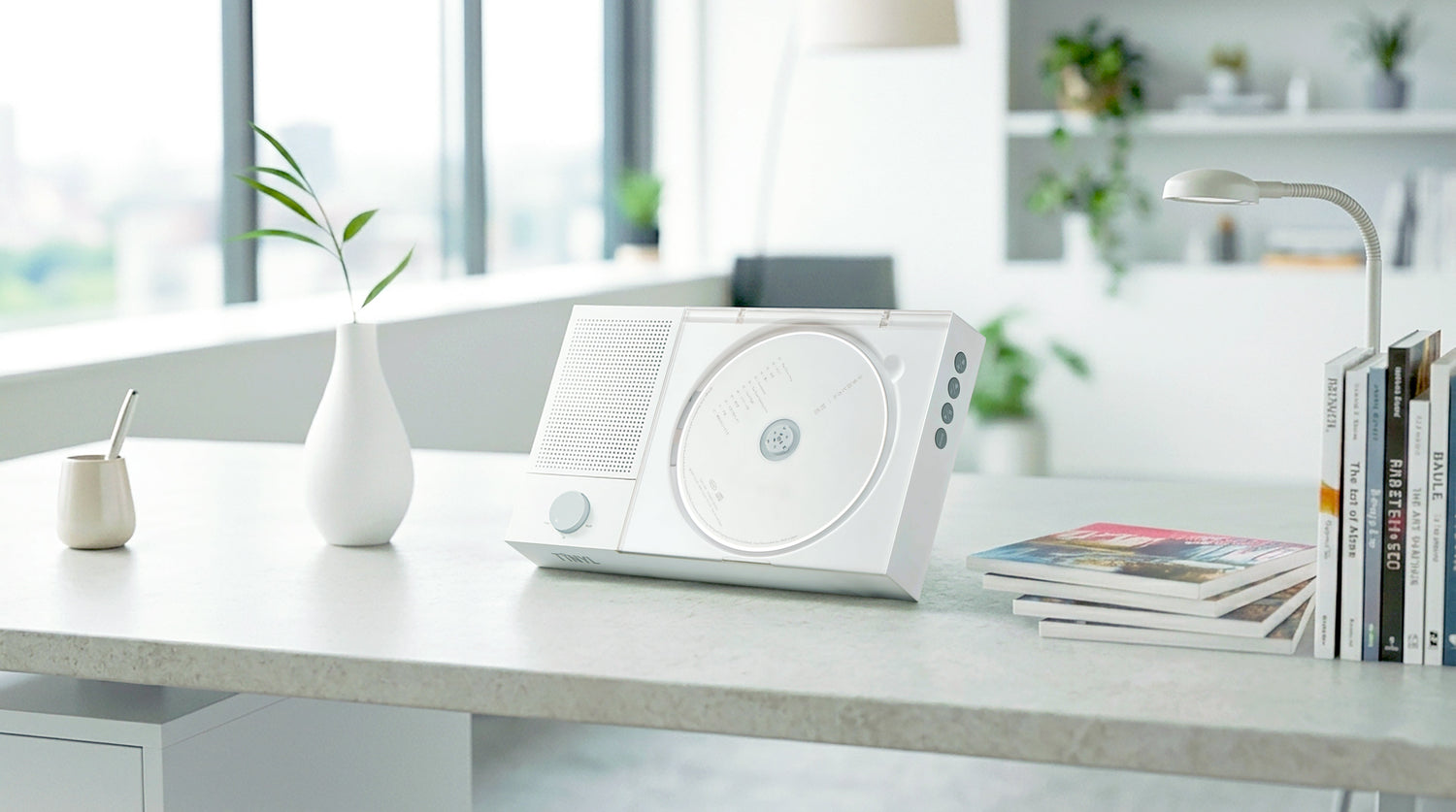
There was a time when music had a place.
The stereo stayed in the living room.
The CD player sat neatly on a shelf.
Speakers remained exactly where they were placed.
But life has changed.
We move between rooms.
We work from home.
We cook while listening.
We read in bed.
Sometimes we simply follow where the sunlight falls.
Yet most audio systems still assume that listening happens in one fixed location.
SPLIT was designed with a different idea in mind.
Because music, like life, rarely stays still.
 Beyond the Traditional Audio System
For decades, music systems have followed the same logic.
A player.
A pair of speakers.
A permanent setup.
Functional, but immovable.
SPLIT questions this assumption.
Its magnetic architecture separates the CD player and speaker into independent objects.
Together, they form a complete music system.
Apart, they adapt to different spaces and moments.
The speaker becomes a portable Bluetooth companion.
The CD player can wirelessly transmit music to headphones or other speakers.
And when reunited, they become one again.
Not because technology demands it.
But because daily life does.
 Designed for Changing Spaces
Homes today are increasingly fluid.
The boundaries between living rooms, bedrooms, and workspaces are becoming softer.
Furniture moves.
Objects evolve.
Listening habits change throughout the day.
SPLIT responds to this rhythm.
Morning coffee on the kitchen counter.
An afternoon playlist beside the desk.
Late-night albums shared quietly in the bedroom.
Music no longer belongs to a single corner of the house.
It travels naturally with the people who live there.
Because perhaps home is not defined by walls.
But by the atmosphere we create.
 Simplicity Through Separation
Separation is often misunderstood as complexity.
But sometimes, dividing things creates freedom.
The magnetic connection allows the speaker and player to function independently without losing their relationship.
No cables.
No complicated setup.
No visual clutter.
Only the flexibility to choose how music fits into each moment.
Technology should adapt to life.
Not the other way around.
 Objects Meant to Be Touched
Digital music has made listening invisible.
Albums exist somewhere in the cloud.
Playlists arrive endlessly.
Songs become background noise.
CDs offer something different.
A cover to hold.
Lyrics to read.
A beginning and an end.
SPLIT preserves this ritual while allowing it to coexist with modern lifestyles.
Physical music and wireless freedom no longer need to oppose each other.
They can complement one another.
Just as tradition and technology often do.
 Music as an Atmosphere
Perhaps music isn’t something we simply listen to.
Perhaps it is something we live inside.
Not a device sitting on a shelf.
Not a collection of specifications.
But a quiet presence that moves through different spaces with us.
SPLIT was never designed to stay in one place.
Because neither do we.
 FAQ
FAQ
Why is SPLIT separated into two parts?
Because modern life isn’t fixed.
The magnetic speaker and CD player can function together or independently, allowing music to adapt naturally to different spaces and occasions.
Does separating the speaker compromise sound quality?
Not at all.
SPLIT uses carefully tuned acoustic design and wireless technology to provide a balanced listening experience, whether connected or used independently.
Why CDs in the age of streaming?
Because physical music creates a different relationship with listening.
Albums become experiences rather than endless choices.
And sometimes, slowing down allows us to hear more.